


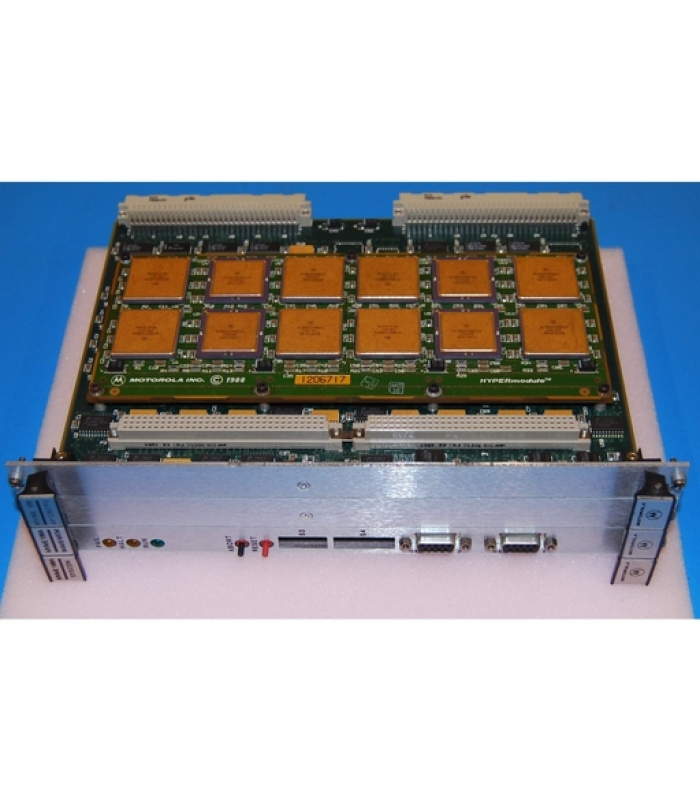
Motorola MVME188A 6U Single-Slot VME Modular Multi-CPU SBC (MC88100 RISC, A Revised Industrial Version)
- Product Code: MVME188A
- Availability: In Stock
Motorola MVME188A 6U Single-Slot VME Modular Multi-CPU SBC (MC88100 RISC, A Revised Industrial Version)
Manufacturer: Motorola Computer Group, later acquired by Emerson Artesyn
Model: MVME188A (Suffix A = enhanced EMC, signal & power revised hardware over original MVME188)
Series Position: Modular multiprocessor carrier board of MC88000 RISC family, parallel computing predecessor of MC68K MVME162 series
Type: Single-height 6U VMEbus base carrier board, no onboard CPU/memory, dependent on HyperModule CPU mezzanine + MVME288 memory daughter boards to boot and operate
Core Function: High-performance parallel real-time computing node for aerospace ATE, radar signal processing, early distributed industrial control, military rugged VME systems; basic serial/parallel I/O, integrated VME system controller, support symmetric multi-processing SMP; compatible with VxWorks, OS9/88k, OpenBSD/mvme88k
1. Product Overview
MVME188A is a modular carrier-style VME single board computer adopting Motorola MC88100 pure 32-bit RISC multiprocessor architecture. It is the upgraded revision of the original MVME188, optimized for power filtering, high-speed signal crosstalk suppression and electromagnetic compatibility for industrial cabinet environments.
This board cannot run independently, two mandatory auxiliary modules must be installed:
1. HyperModule mezzanine card: carries 1/2/4 MC88100 25MHz RISC CPUs and matching MC88200/MC88204 CMMU cache & memory management units, supporting single-core, dual-core or quad-core symmetric multiprocessing, configurable cache capacity 32KB/64KB/128KB.
2. MVME288 memory daughter boards: inserted into dedicated memory slots on the carrier, optional 16MB parity / 32MB ECC / 64MB parity DRAM per board, maximum 4 memory boards expandable to total 256MB system memory.
The built-in SYSCON sub-board provides basic human-machine communication interfaces and complete VME bus arbitration & system controller functions. There is no native Ethernet, SCSI or IndustryPack expansion slots on the main board; network and storage peripherals need separate VME expansion cards (MVME330 SCSI controller, MVME340 Ethernet card).
Compared with single-core MC68040 MVME162 series, its core advantage is native multi-processor parallel computing capability, suitable for heavy multi-channel signal acquisition, large-scale floating-point algorithm calculation scenarios. Widely used in aerospace flight test equipment, military radar real-time FFT processing, and early large petrochemical distributed control systems before Honeywell TDC3000 became mainstream.
2. Full Technical Specifications
• CPU: MC88100 32-bit RISC, fixed 25MHz, integrated hardware floating-point arithmetic unit
• Cache & MMU: MC88200 (16KB cache per chip) / MC88204 (64KB cache per chip); dual PATC/BATC address translation cache, independent user/supervisor 4GB address space
• HyperModule Options: 1P32 / 1P64 / 1P128 single-core; DP dual-core / QP quad-core multiprocessor modules
• Memory Expansion: MVME288 series memory mezzanines, max 4 pieces, total system DRAM up to 256MB
• Non-Volatile Memory: 2KB lithium battery-backed NVRAM for persistent system configuration; socket for up to 2MB EPROM boot firmware
• Standard Onboard I/O (SYSCON): 2× Z85230 SCC RS232/422 asynchronous serial ports; 2× Centronics parallel printer ports
• VME Bus Interface: VMEbus Rev C.1 full A16/A24/A32 master/slave, D08/D16/D32 BLT/SCT block DMA transmission, integrated VME system arbiter and controller
• Front Panel Indicators & Buttons: RUN, FAULT, VME ACTIVE, POWER GOOD LEDs; manual global RESET and ABORT pushbuttons
• Power Consumption: +5VDC VME backplane power supply, typical 4.0A, maximum 5.0A
• Operating Temperature: Standard industrial grade 0℃ ~ +55℃ with forced air cooling; storage temperature -40℃ ~ +85℃
• Environmental Resistance: 5%~95% RH non-condensing humidity; 1G three-axis sine vibration 5–200Hz; 15g 11ms half-sine shock resistance
• Mechanical Size: Single-height 6U VME Eurocard, 233.4mm (H) × 160.0mm (W) × 20mm (D), occupies one VME chassis slot
• Supported RTOS: OpenBSD/mvme88k (SMP support), VxWorks 5.x, Motorola proprietary OS9/88k real-time executive
3. MVME188A vs Original MVME188 Upgrade Differences
1. Power circuit optimization: Added multi-stage filter capacitors to reduce power supply switching ripple and noise
2. PCB routing improvement: Orthogonal separated address/data traces to eliminate high-speed signal crosstalk at 25MHz clock
3. Driver chip upgrade: Replace CMOS bus drivers with TTL drivers to suppress signal overshoot and ringing
4. EMC reinforcement: Add local shielding covers for CPU clock high-speed traces to reduce cabinet EMI interference
5. Refresh circuit optimization: Single-cycle DRAM refresh design to lower overall power fluctuation amplitude
4. Core Differences vs MVME162 MC68040 Series
1. CPU Architecture: MVME188A = MC88100 pure RISC, native multi-core SMP support; MVME162 = MC68040 CISC single-core only, no multi-processor capability
2. Cache Resource: MVME188A independent CMMU cache up to 128KB; MVME162 only 8KB unified shared cache
3. Memory Capacity: MVME188A expandable up to 256MB via external memory mezzanines; MVME162 maximum 16MB onboard fixed DRAM
4. Native Peripherals: MVME188A only serial/parallel ports, network/SCSI need separate expansion cards; MVME162 integrated Ethernet + SCSI + 4 IndustryPack I/O expansion slots
5. Application Orientation: MVME188A for parallel heavy computation; MVME162 standard single-core host for Honeywell TDC3000 LCN operator stations
5. Industrial Application Scenarios
• Aerospace ATE automated flight test equipment parallel signal processing host
• Military radar multi-channel real-time FFT data acquisition and computing node
• Early large petrochemical distributed process control heavy calculation rack controller (pre-TDC3000 mainstream hardware)
• Rugged multi-processor VME computing cabinet for avionics simulation systems
• High-channel industrial multi-loop complex control algorithm real-time computing main board
Motorola / Artesyn © MVME188A Modular Multi-CPU VME Single Board Computer